Bitcoin data can describe a transaction, a block, a node's view of the chain, or a price observed in a market. Those are different subjects. A clean Bitcoin API integration makes their boundaries visible instead of presenting everything as one stream of interchangeable numbers. This matters whether the final application is a research screen, an operational monitor, or a wider asset-data interface.
This article develops a read-only data design. It does not prescribe transaction approval thresholds, recommend investments, or imply that a particular price is executable. Its purpose is to help a developer specify Bitcoin records accurately and connect them to a broader altcoin data model without treating Bitcoin as a token contract.
Start with native Bitcoin identity
Give Bitcoin an explicit native-asset record within a specified network. A production-network observation should not collide with a testing-network observation because both use the display symbol BTC. Keep the network, asset type, denomination, and source context in separate fields. Avoid filling an absent contract address with a made-up address merely to satisfy a shared token schema.
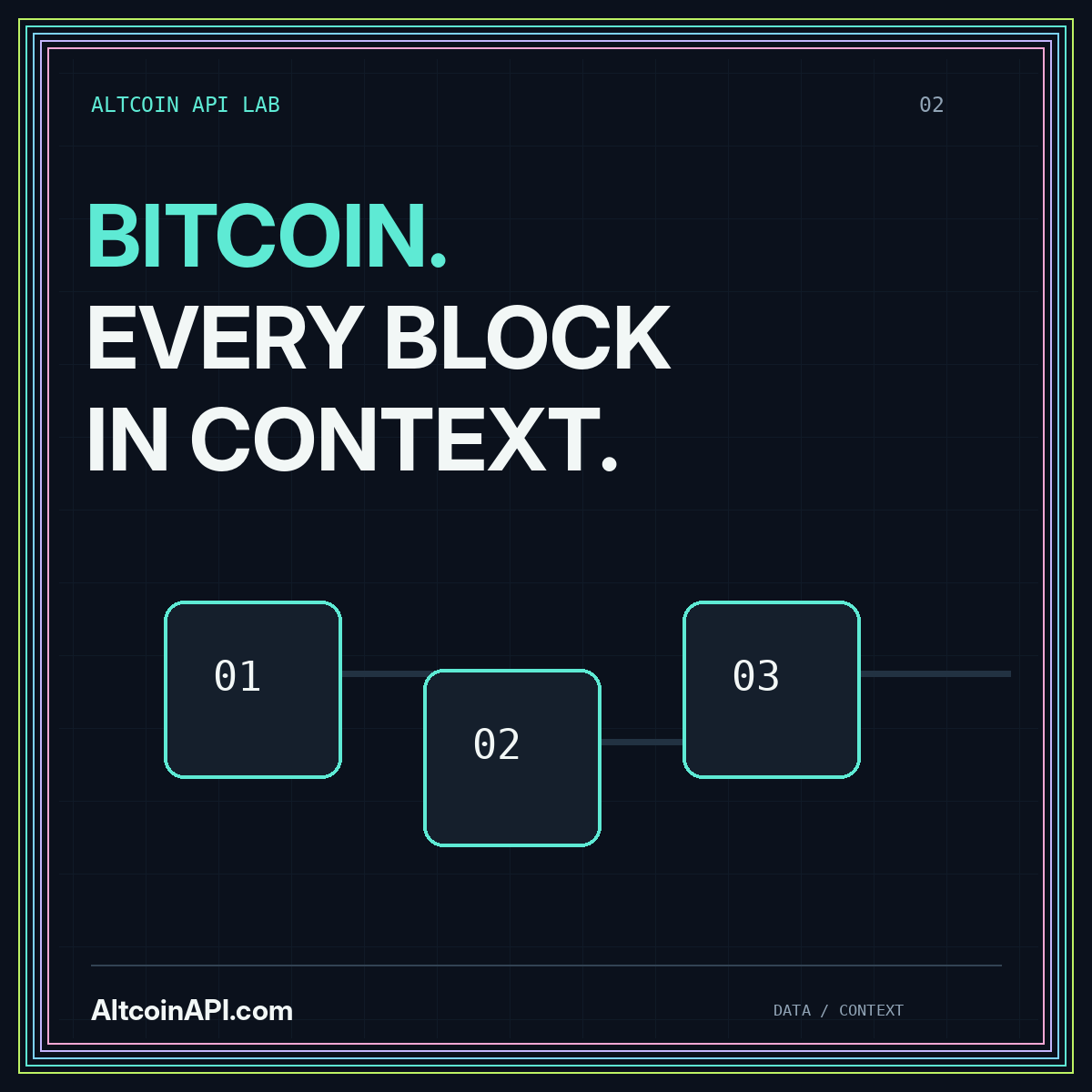
Separate transaction identifiers from block identifiers. An application may first encounter a transaction before it has a block context, while a later observation associates it with a block. Model that evolution directly. A transaction table, a block table, and a relationship between them are easier to interpret than a flattened record with unexplained blanks.
When displaying an identifier, retain the complete value in storage even when the interface abbreviates it. A short label is a convenience for readers, not a substitute for exact matching. Use a consistent display rule. Never ask users to identify a record from a ticker and a partial hash alone.
Describe the source node's chain view
Bitcoin Core's documented getblockchaininfo response includes the chain name, validated block height, best block hash, and synchronization progress. These describe the responding node's view. The Bitcoin reference note identifies the official documentation behind those definitions.
For an integration, retain a source identifier and collection time next to that view. When two sources disagree, those fields help determine whether the difference came from timing, synchronization, or another collection issue. Do not immediately treat the highest returned number as the correct answer without understanding the source and validation context.
A monitoring interface can distinguish source reachable from source sufficiently synchronized for this task. These conditions require different checks. Receiving valid JSON proves a response arrived; it does not establish that the source is ready to supply the observation your application expects. Make the readiness rule explicit and keep it separate from a connection indicator.
Preserve block context and confirmations
Bitcoin Core's getblock documentation describes block hashes, heights, previous-block references, and confirmation counts, including a negative count for a block outside the active chain. The block-response reference records that source attribution.
Retain the hash used when a record was ingested and the chain view under which the record was accepted. If a later update changes that relationship, publish a revision rather than silently leaving both observations marked current. Applications consuming the data need enough information to remove or replace affected derived records.
Confirmation policy belongs to the consuming application and its operational requirements. A feed can report an observed count, but that number does not select an appropriate business rule on the user's behalf. Label it as an observation at a time, not a permanent property. An archive preserving only the latest count cannot reproduce what an earlier interface showed.
Keep pending activity separate from settled history
Treat observations of pending transactions as their own dataset with a source and observation time. A local pending view should not be described as a complete historical record of all network activity. A transaction's appearance, disappearance, and later inclusion are different events that an application may need to preserve independently.
Define how the pipeline handles a record that disappears from a source's pending view. Absence should not automatically become a statement that the transaction was rejected everywhere. A schema can express no longer observed by this source without inventing a reason. This keeps operational messages honest when collection coverage is incomplete.
For research, decide whether the requested history includes pending observations at all. An archive of confirmed block records and an archive of observed pending activity answer different questions. Combining them without labels risks double counting a transaction as it moves between states. An explicit event type and stable transaction key make reconciliation possible.
Do not confuse chain data with price data
Keep market observations separate from block observations in the proposed schema. A quote record should identify its source, trading instrument, quotation currency, price type, and timestamp. A last-trade value, a calculated reference value, and an executable quote should not share an unlabeled price field. This separation makes the interpretation of a combined display reviewable.
Define how a historical block observation is joined to a historical price observation. A nearest-time join can accidentally use a value published after the event being studied. A research workflow may instead require the most recent eligible observation available before its decision time. Write the rule down and preserve the source timestamps needed to reproduce it.
Decide whether missing or old market observations invalidate a combined record. A screen could continue displaying chain fields while withholding a derived valuation. That behavior is more informative than substituting zero or carrying a previous price forward without an age label. The record should communicate what is known and what is unavailable.
Build a recoverable historical pipeline
For each retrieval job, record the network, requested range, source, schema version, and completion state. Divide large histories into ranges that can be checked and resumed. A checkpoint should identify a verified position, not merely the last request attempted. Otherwise a failed page can create a silent hole while the job appears finished.
Use stable keys to make repeated delivery safe. Replaying a range should reproduce the same observations or provide explicit revisions, rather than increase apparent activity every time it runs. Keep logs of skipped and unavailable intervals separately from successful results so downstream users do not confuse an empty response with an empty period.
Test recovery by interrupting a job on purpose. Resume it, compare the resulting records with an uninterrupted run, and inspect mismatches. This gives a more useful acceptance signal than a demonstration where every request succeeds. Include a changed active-chain relationship in the sample so corrections receive the same scrutiny as initial ingestion.
Review a failed interval
Imagine a retrieval job completes nine ranges and fails on the tenth. Its manifest should identify nine completed ranges and one unresolved range, not call the entire request complete. After recovery, compare record identities at both neighboring boundaries. This checks for duplicated boundary records as well as missing data in the failed range.
Specify the feed with measurable boundaries
A Bitcoin feed brief should distinguish required chain state, block history, transaction detail, pending observations, and optional market context. State the historical period and freshness requirement for each component independently. A daily research export and an operational display do not need identical delivery arrangements simply because both concern Bitcoin.
Ask the provider to document missing intervals, supported query limits, correction behavior, and retention terms. When discussing speed, separate request-response time from source-observation age. When discussing availability, define whether the measure describes the website, delivery endpoint, or completeness of requested data. These distinctions prevent impressive but irrelevant service claims from shaping the integration.
Store the accepted definitions with the sample output. A future migration should be evaluated against the same meanings rather than only the same property names. A new provider may have a different interpretation of freshness or confirmation context. Differences should become explicit mapping decisions, not silent changes inherited by the application's users.
Conclusion: retain enough context to explain a record
The strongest Bitcoin data design is not the one with the most fields. It preserves native identity, source perspective, block context, observation state, and separate market inputs used in calculations. Begin with the Bitcoin API coverage page, then use the custom feed planning guide to turn those choices into a reviewable requirement.