Altcoin data.
Built for
what’s next.
Bitcoin. Ethereum. Solana. The next layer of Web3.
Shape a custom data feed around the assets, evidence, and insights your application needs.
{
  "network": "bitcoin",
  "asset_type": "native",
  "identifier_type": "native_asset",
  "fields": [
    "block_hash",
    "height",
    "source_time"
  ],
  "mode": "illustrative_schema"
}
{
"network": "ethereum",
"asset_type": "token",
"identifier_type": "contract_address",
"fields": [
"raw_amount",
"decimals",
"block_hash"
],
"mode": "illustrative_schema"
}{
"network": "solana",
"asset_type": "token",
"identifier_type": "mint_address",
"fields": [
"raw_amount",
"decimals",
"slot_context"
],
"mode": "illustrative_schema"
}YOUR FOUNDATION
The right context.
For every kind of asset.
Native assets, token records, and offchain evidence deserve more than a shared ticker.
Bitcoin API
Build a Bitcoin dataset that distinguishes a source’s chain view, block history, transaction observations, and separately sourced market context.
Ethereum Altcoin API
Keep contract identity, token metadata, event observations, and derived views connected—but clearly distinct.
Solana API
Connect mint identity, token-account scope, exact balances, and program context in a record your application can explain.
Web3 Token API
Give names, categories, and summaries an origin—and preserve the evidence behind the words your users see.
RWA Data API
Connect token state to asset evidence without treating one as proof of the other.
AI Altcoin Data API
Build with traceable inputs, reproducible features, and summaries that stay connected to the evidence.
A token is only
half the record.
Connect a specific mint to dated evidence about the asset it represents. Keep technical state, issuer statements, and valuation context separate enough to review.
Better inputs.
More accountable outputs.
Design model-ready records and evidence-linked features. Preserve the source behind a label, the method behind a calculation, and the uncertainty behind an interpretation.
RECORDS→DEFINED
FEATURES→REVIEWABLE
CONTEXT
AI-related token research, data for AI applications, and AI enrichment are different requests. Define the output before choosing the pipeline.
Explore AI altcoin dataA clearer path from
requirements to records.
Plan your premium feedName your universe.
Specify networks, native assets, contracts, mints, and the evidence relationships that matter to the application.
Make meaning explicit.
Agree fields, units, timestamps, history, missing-value behavior, and the distinction between raw and derived data.
Test a useful sample.
Review difficult records, corrections, and recovery paths. Confirm source rights, delivery capabilities, and commercial scope.
Coverage, delivery patterns, pricing, and operating requirements are confirmed for each project. The examples on this site are illustrative—not production access.
Less noise. More understanding.
Read all ten guides
Solana Token Data: Mints, Accounts, and Precise Balances
Understand mints, token accounts, exact amounts, commitment settings, and the limits of derived holder metrics.
Read the guide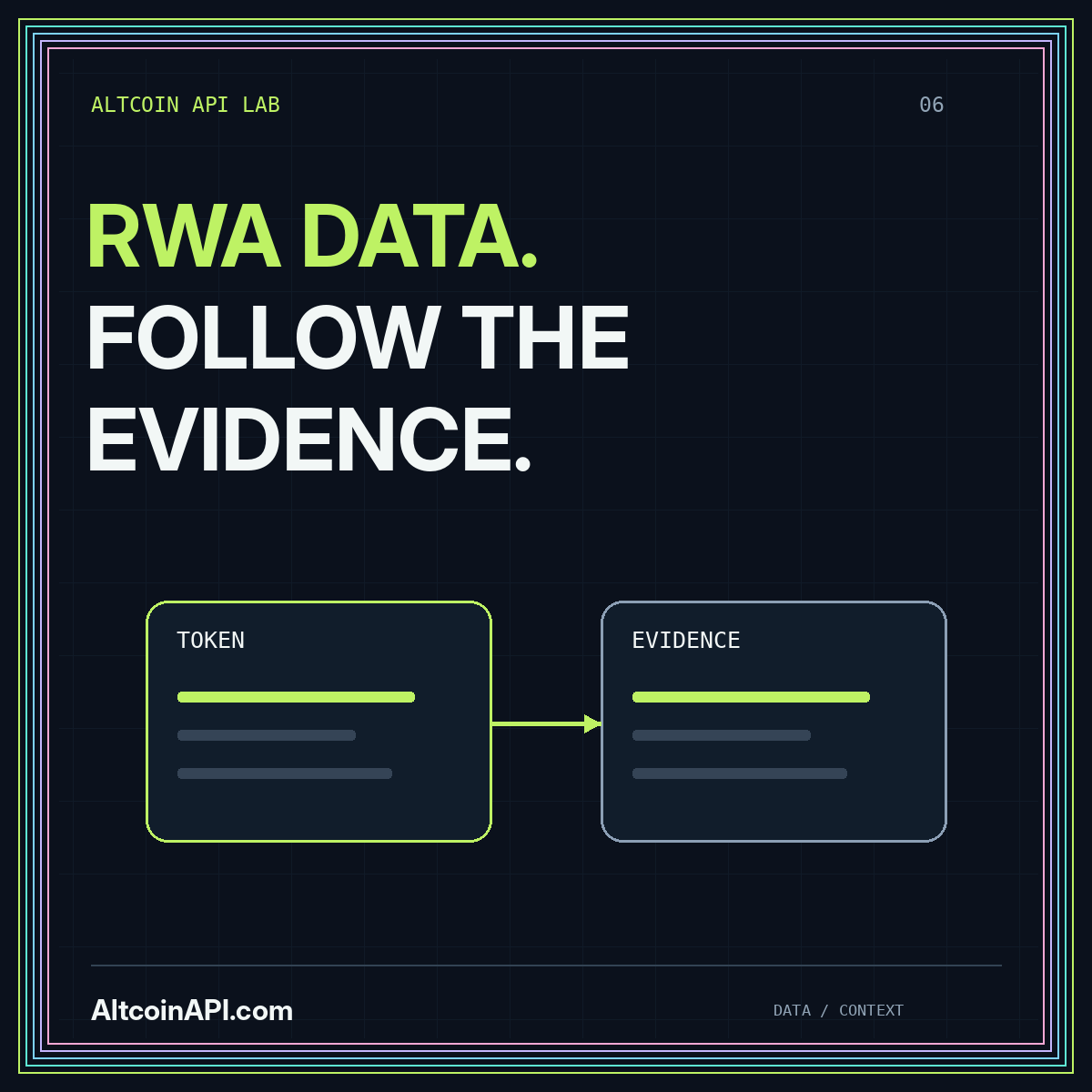
RWA Data: Separating Token State from Asset Evidence
Build two connected records: current technical state and dated evidence about the asset or claim a token represents.
Read the guide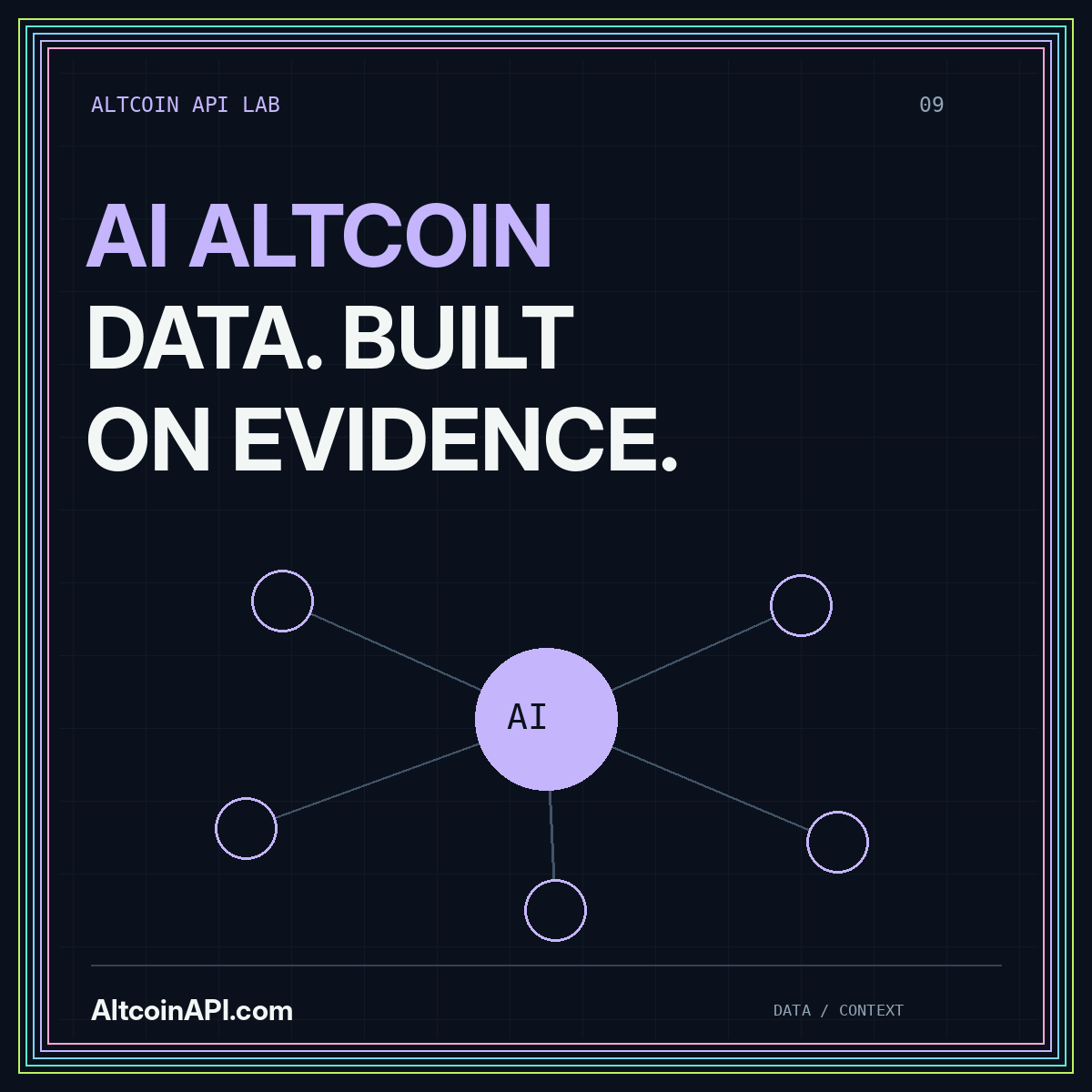
AI Altcoin Data: Building Evidence-Linked Features
Specify AI-related token research, model-ready records, and evidence-linked enrichment without inventing certainty.
Read the guideGood data starts
with better questions.
Understand the scope, the examples, and the difference between an observation and an assurance.
Read every answerWhich assets does AltcoinAPI focus on?
The editorial and feed-planning scope is Bitcoin, Ethereum, Solana, Web3 tokens, RWA, tokenized assets and altcoins on Solana, Ethereum altcoins, and AI altcoin data. Individual dataset availability and identifiers need confirmation for a project.
Is the code example a live API response?
No. The examples are illustrative data contracts stored locally on this website. They do not connect to a production endpoint, carry a current market observation, or grant API access.
How are premium feeds priced?
Pricing depends on the agreed asset universe, fields, history, delivery needs, permitted use, and support scope. No fixed prices or service-level guarantees are published here.
How is RWA evidence different from token data?
A blockchain observation describes technical state. An issuer document, valuation, or representation statement is a separate evidence record with its own scope and dates. A fresh token observation does not verify or refresh that evidence.
Your next build starts with better data.
Define your assets, fields, evidence, and delivery needs. Start with a clear brief—not an assumed service package.