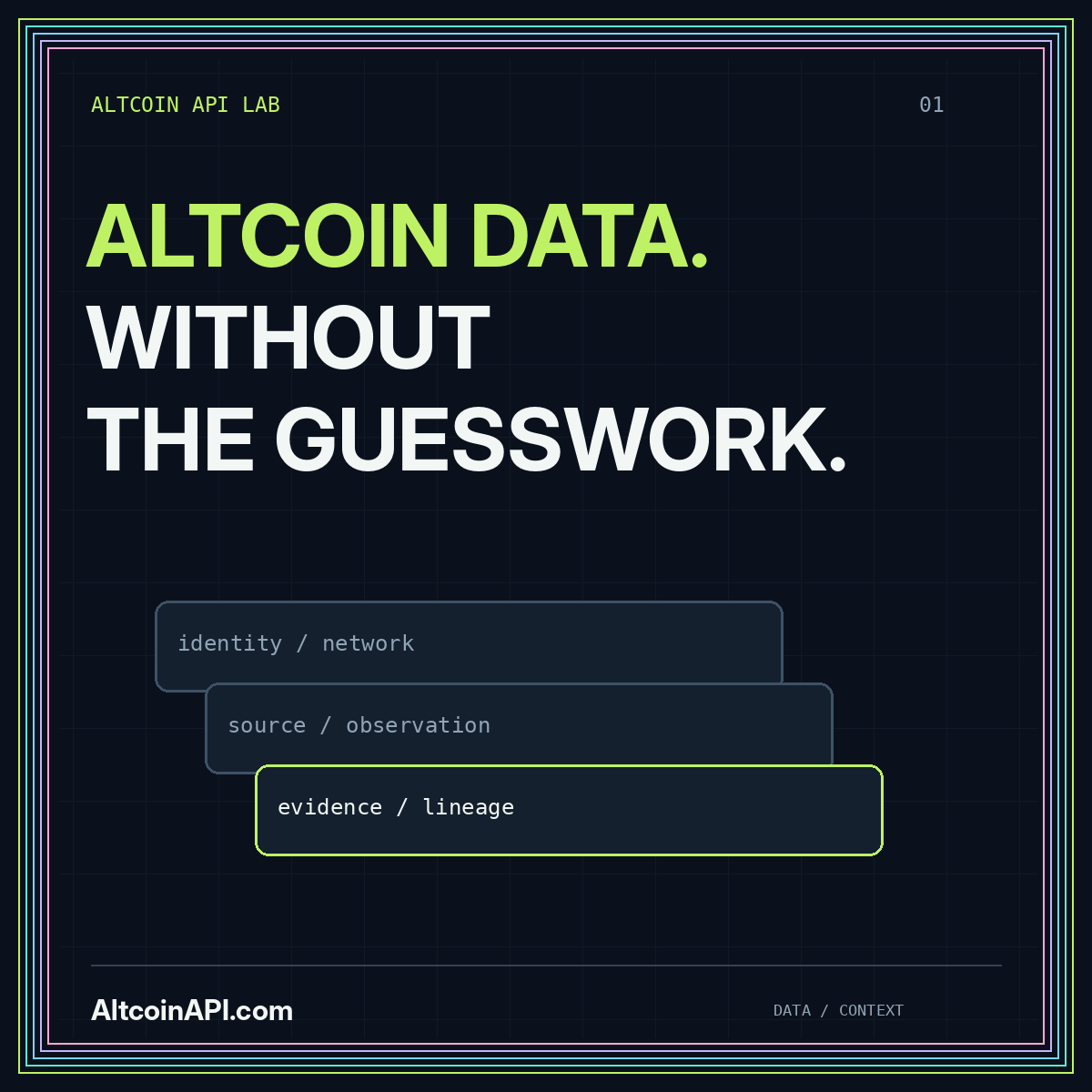
An altcoin data API becomes useful when its records have a meaning your application can preserve. A token name, a balance, and a timestamp may look sufficient for a first dashboard. They are not sufficient to explain which asset was measured, which network supplied the observation, or whether a correction has changed the result. Begin with those questions rather than an attractive response format.
This guide proposes an integration workflow for Bitcoin, Solana, Ethereum, and the Web3 tokens within the agreed coverage of a feed. The workflow is an engineering specification, not a claim that every dataset or delivery option is already available. Use it to make a requirements brief that a provider can accept, reject, or narrow before development begins.
Define the job before selecting fields
Write one sentence describing the decision that the data must support. A developer displaying token balances needs a different record from an analyst studying historical transfers. An RWA research screen needs evidence about the represented asset as well as a blockchain identifier. Combining all three into an undefined market-data requirement creates ambiguity that is expensive to resolve later.
For a balance interface, describe the network, owner identifier, token set, observation state, and refresh policy. For a research archive, describe the date range, point-in-time behavior, correction history, and acceptable gaps. For a custom AI feed, state whether the required output is a classification, a numerical feature, or a written summary. These are separate deliverables even when they share source records.
Decide what happens when a required input is missing. A page might display “not available,” retain the previous observation with an age label, or withhold the calculation entirely. Document that behavior before choosing an interface. Otherwise, different clients will invent different meanings for the same empty field.
Build an identity model that survives ambiguity
Use an asset identifier that includes its network and native identifier. Keep display names and tickers separate from that identity. A symbol is useful to people but is not an adequate database key. Store the label as metadata with a source and observation time. A label change should update the display history without silently creating a new asset or merging two unrelated records.
Represent relationships explicitly. A token on Solana that references an Ethereum asset needs its own identity plus a relationship to the referenced asset. The relationship should describe what has actually been established, not simply copy a shared name. The tokenized altcoins guide develops this distinction without assuming that similar branding proves equivalence.
Keep a native-asset classification for Bitcoin and ETH instead of forcing them into a token-contract field. A common response envelope can accommodate different asset types without pretending their underlying records are identical. The protocol reference notes explain the source concepts used in the network-specific guides.
Separate raw observations from derived outputs
Retain the source value before applying formatting or calculation. An amount represented as an integer string can be stored alongside decimal precision and a separately computed display amount. Preserve the rounding rule used for any subsequent aggregation. This gives developers a way to investigate a surprising number rather than reverse-engineer it from a rounded interface.
A derived field needs a definition. A holder count should say what kind of holder was counted. A price should identify its quotation currency and methodology. A token classification should state whether it was assigned by an issuer, an analyst, a rule, or a model. Identical field names do not guarantee identical calculations across feeds.
Keep a compact lineage record for each transformation: input record identifiers, transformation version, output time, and known limitations. For a small deployment this may be an accompanying manifest rather than a separate service. A consumer should be able to answer what information produced a value without relying on a marketing description.
Make time and observation state explicit
One timestamp rarely describes a complete data lifecycle. Distinguish the time associated with the underlying event from the time the collector observed it and the time the feed published it. A historical backfill can arrive today while describing an earlier event. Treating delivery time as event time would move that activity into the wrong research period.
Store the relevant chain position and observation state with blockchain records. Do not translate network-specific contexts into an unexplained confirmed boolean. Our Bitcoin data guide and Solana data guide describe the different information a client should retain. Those choices should remain visible when records are compared across a shared interface.
For time-window queries, specify a boundary convention. A project may use an inclusive start and exclusive end, expressed in UTC. This is a proposed contract convention, not a universal API rule. Documenting it prevents adjacent exports from duplicating or dropping records at midnight and makes repeated research runs easier to compare.
Design for pagination, retries, and corrections
Ask what a pagination cursor means and whether it is bound to a stable dataset view. A cursor into a changing collection may behave differently from a cursor into an immutable export. Record the filters, schema version, and snapshot identifier alongside the cursor so that a resumed job cannot accidentally continue a different query.
Give each record a stable identity and each revision a distinguishable version. Consumers can then accept a repeated delivery without counting it twice and apply a correction without erasing the original observation. Test both operations deliberately. A feed that works only when every message arrives once and in order is not a complete integration design.
Define bounded retries, a recovery checkpoint, and a visible failure state. A repeated request should not loop forever while a dashboard continues to imply freshness. For larger histories, a dated export plus subsequent changes may be more practical than repeatedly requesting the entire dataset. Choose the pattern around the use case and agreed usage terms.
Evaluate a sample with written acceptance tests
Request a sample covering ordinary records and awkward cases. Include missing metadata, an asset with a changed label, a repeated event, an out-of-order delivery, and an unavailable interval. For tokenized assets, include a record whose offchain evidence is older than its onchain observation. These cases reveal whether the schema communicates uncertainty instead of hiding it.
Measure properties you can reproduce: required-field completeness, identifier consistency, timestamp ordering, duplicate handling, and the ability to resume after interruption. Latency needs an agreed starting point and ending point. A fast response from a cache says little about the age of the underlying observation. Avoid comparing numbers that describe different parts of delivery.
Keep commercial evaluation separate from technical evaluation. Confirm permitted storage, internal use, redistribution, model processing, retention, and support arrangements with the provider. A custom premium feed brief should record these questions alongside the requested fields, rather than leave usage permissions to an assumption made after integration.
Work through one record from source to screen
Take a single Solana token observation and write down every transformation before it reaches the interface. The collector receives a raw amount and mint identifier. A normalization step attaches network and observation context. A formatting step applies known precision. A metadata step selects a display label under a documented policy. Finally, the interface checks age and quality state.
Now remove the label and replay the example. The identity and amount should survive even though presentation becomes less friendly. Next remove precision: the raw observation can remain stored, but the formatted amount should follow the missing-data policy. This exercise exposes hidden dependencies and is easier to debug than a full dashboard containing hundreds of assets.
A practical handoff
Give the next engineer the sample, field dictionary, acceptance tests, and one completed trace from source to screen. Ask them to reproduce the result without verbal instructions. Any missing explanation belongs in the contract or its supporting notes, not only in the memory of the person who built the first integration.
Conclusion: make the contract understandable
A useful integration is one another engineer can inspect and explain. Asset identity, provenance, time, numerical precision, recovery behavior, and usage terms deserve the same attention as endpoint shape. Start with a narrow dataset and expand only when its meaning stays clear. Continue with the sample data dictionary or use the contact brief to describe your requirements.