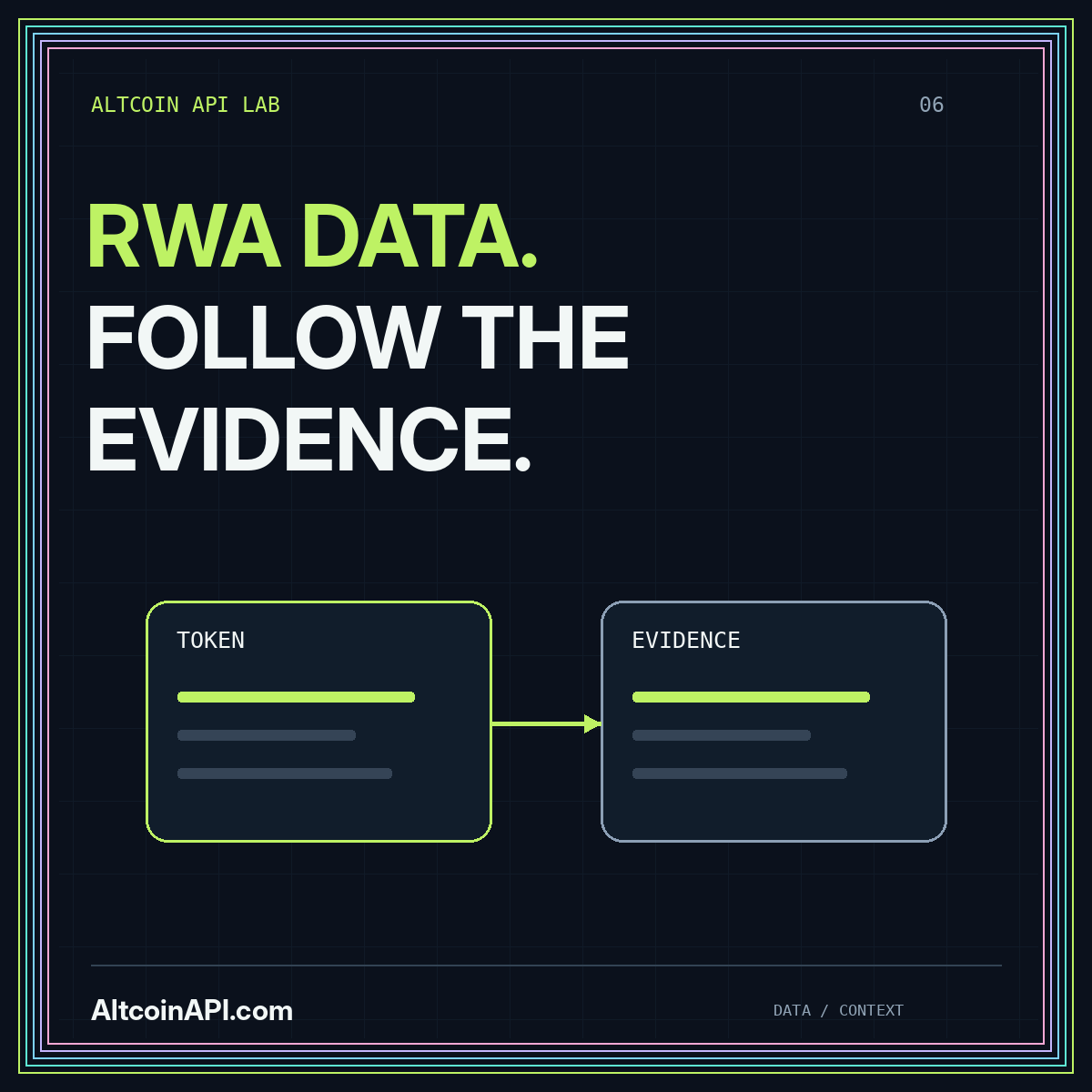
An RWA data API needs to describe two things that can change independently: a token record on a blockchain and evidence about the asset or claim associated with it. A current mint-supply observation does not update an issuer document. A document describing an asset does not establish the latest token state. A useful feed keeps both timelines visible.
This guide proposes an evidence-oriented model for RWA research, especially tokenized assets on Solana. It is a data-design discussion, not legal advice, an investment recommendation, or verification of an issuer. The RWA coverage page describes the scope to agree before a custom dataset is assembled.
Ask what the token represents
Begin with the stated relationship between token and reference asset. Investor.gov's Tokenized Securities overview distinguishes issuer-sponsored, custodial, and synthetic models. The RWA source note identifies that educational reference. These distinctions are a reason to inspect the applicable documents rather than assume all tokenized instruments confer identical rights.
Do not assign a structure from the token's name. Create a relationship record with source-document identifier, stated issuer, effective date, and review status. Where documents do not support a clear interpretation, mark the relationship unresolved. Missing evidence should not be replaced with the most familiar structure to complete a comparison table.
Preserve source wording separately from normalized summaries. A reviewer may condense a long explanation into a compact field, but the original statement should remain accessible under the project's permissions. Later reviewers then have a way to assess whether the summary retained important qualifications or made a relationship appear stronger than supported.
Keep an onchain record and an evidence record
The onchain record identifies network, token identifier, relevant program or contract, amounts, and chain context. The evidence record identifies documents, reported valuations, attestations, or issuer statements the project may use. Connect them through an explicit relationship rather than placing every field into an undifferentiated asset object.
This division makes missing information understandable. A technical token record may exist while supporting documents are unavailable. A document may cover an issuer or product family without establishing its application to one mint. State the scope of every source. Evidence concerning one product should not automatically validate similarly branded tokens.
For Solana, preserve mint identity and token-program context in the technical record. Attach the relationships needed for the research use case separately. The Solana tokenized-asset checklist explains how observed capabilities and offchain descriptions can travel together without being mistaken for the same type of claim.
Give each important fact its own date
Record blockchain observation time, evidence publication date, evidence effective date, and collection time separately when available. A newly published document may describe an earlier valuation. A balance retrieved this morning does not refresh that valuation. One last-updated label hides precisely the age difference a careful reader needs to understand.
Define freshness requirements by field, not page. A project may need frequently refreshed technical state but accept less frequent documentary updates under an explicit review policy. Those are project requirements, not universal standards. Specify the maximum acceptable age for each evidence class and what happens when that threshold is exceeded.
An interface can show several clocks clearly. A technical panel can carry its observation time while an evidence panel shows a document's effective date. If a combined calculation depends on both, expose the alignment rule and mark mismatches. Refreshing a screen should not make older evidence appear newly verified.
Distinguish valuation from market observations
Give reported asset valuation, observed token trading price, and stated redemption value separate fields with currency, units, source, time, and methodology. A generic value field invites consumers to substitute one quantity for another without noticing the changed meaning. Preserve missing values instead of selecting whichever number happens to be available.
Before combining supply and valuation, establish that the units correspond. The represented relationship may require interpretation and a supported conversion rule. The data team should not invent a conversion factor when documents are incomplete. Retain the inputs and withhold the derived result until the relationship and calculation policy are sufficiently defined.
Keep reported asset size separate from trading liquidity. For a research feed, define any liquidity metric independently and document the market observations used in its calculation. The purpose is to make evidence comparable, not hide different concepts behind one prominent number that appears to describe every aspect of the product.
A deliberately incomplete example
Consider a hypothetical token whose technical state was observed today but whose latest permitted asset report concerns last month. A feed can display both dated records. It should not present a combined valuation as current merely because one component is current. The consumer needs a defined policy for whether to display, qualify, or withhold that calculation.
Model lifecycle changes rather than static promises
Documents, product names, transfer conditions, and descriptions of redemption processes may change. Treat updates as dated evidence events with source and review state. A historical archive should retain what was stated before each revision rather than replace earlier descriptions with current wording across every past observation.
For redemption-related fields, record the process described by the source and the applicable date. Distinguish a stated policy from an independently observed completed process. A field saying a process exists does not establish availability for every holder under every condition. Eligibility, conditions, and access require their own supported descriptions.
Use specific operational language. Document unavailable, statement awaiting review, and evidence expired under the project's policy communicate different limitations. They are more informative than a broad favorable or unfavorable rating without methodology. Where legal interpretation is necessary, route the question to qualified review instead of manufacturing a conclusion in the pipeline.
Build evidence lineage into delivery
Give each document a stable internal identifier and version. Record who supplied it and the transformation extracting displayed fields. An integrity reference can help detect file changes, but integrity is separate from truthfulness of content. Make those review dimensions explicit instead of allowing a successful file check to become a verified-asset claim.
If a reviewer approves a field, retain the approval's scope. The review may check transcription rather than legal effect or asset existence. A precise record prevents a limited operational check from becoming an exaggerated assurance in a downstream interface. Include these distinctions in the dictionary and export manifest.
Keep source descriptions accessible through local methodology notes when a public website requires internal-only links. Contracted access to underlying documents should follow agreed permissions. Linking policy and evidence quality are separate issues: local navigation does not eliminate the need for a meaningful internal source trail.
Test the uncomfortable cases
Include recent technical observations paired with older evidence, a document covering several products, an ambiguous token-to-document mapping, conflicting issuer descriptions, and an unavailable effective date. Write expected behavior before sample evaluation. Every case should produce a clear state instead of an invented value or an unsupported positive conclusion.
Test corrections across both timelines. A revised document may change interpretation of an earlier period without changing an onchain amount. A revised technical observation may change supply without introducing a document. The pipeline should update the relevant component and identify affected derived records without rewriting unrelated evidence.
Ask a reviewer to reconstruct one display from the evidence manifest. If they cannot, determine whether the gap is source access, scope, timing, or transformation logic. This exercise evaluates transparency before commercial delivery choices are compared. Preserve the example as an acceptance test for later schema or methodology changes.
Conclusion: expose the relationship, not just the token
RWA data is more useful when readers can distinguish technical state, reported evidence, interpretation, and missing information. Separate identities and timelines, define value fields, and preserve lifecycle changes. Use the custom premium feed brief to specify those requirements without treating tokenization itself as proof of ownership, backing, or redemption availability.