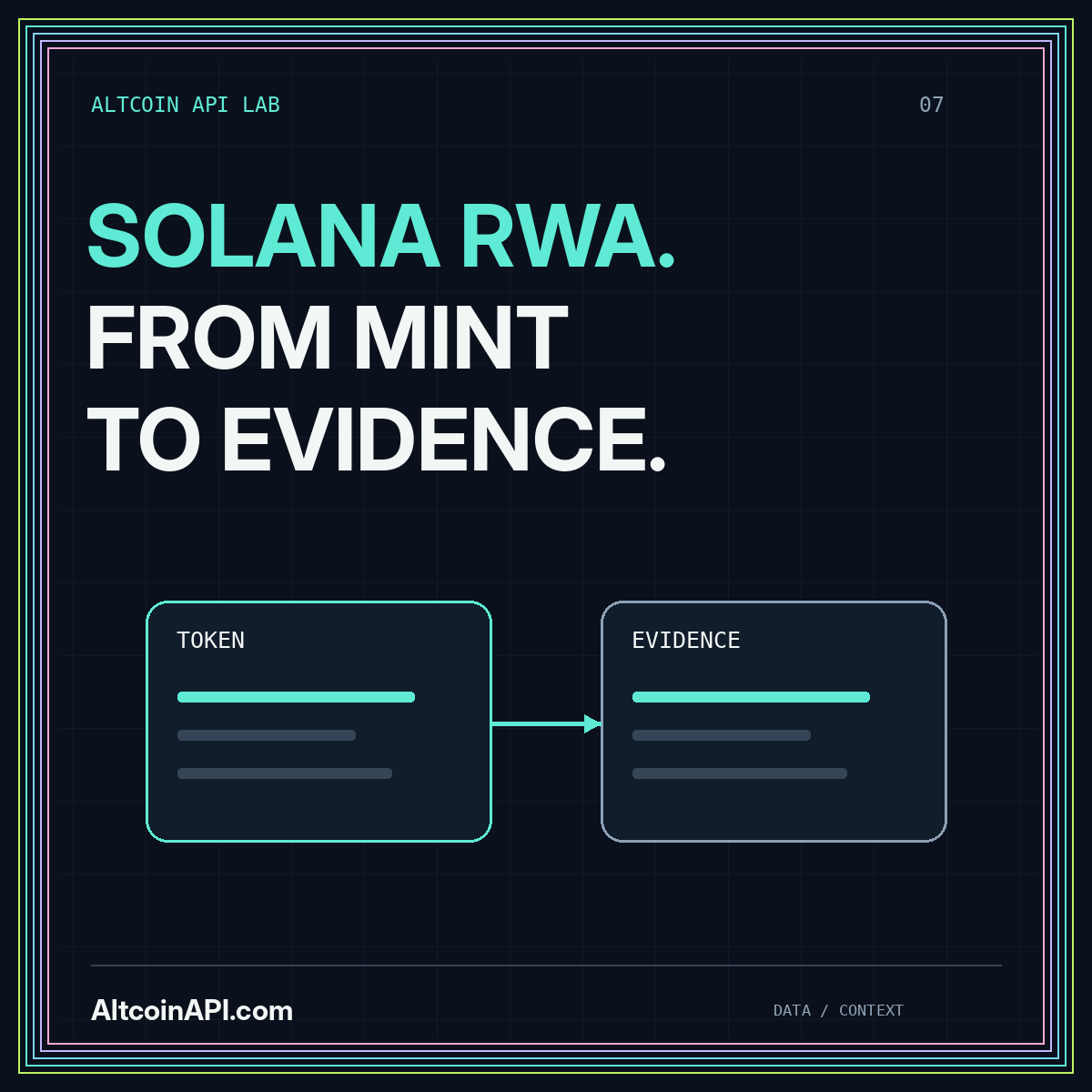
Tokenized assets on Solana require a workflow connecting a specific mint to a specific body of evidence. The integration needs technical account context alongside issuer documentation, observed capabilities, and uncertain relationships. A list of names is not an adequate inventory when the application must explain what each token record concerns.
This checklist is for developers specifying a read-only research or reporting feed. It covers collection, time alignment, and acceptance testing. It does not certify an asset or assume a particular legal structure. Begin with the Solana tokenized-assets scope to define the intended product universe before requesting supporting data.
Establish the exact asset inventory
Create an approved list of network-and-mint identifiers before broader enrichment. For each entry, record the mapping's source, the product name used for display, and the person or process responsible for the inventory decision. A mint found through a name search should remain a candidate until sufficient evidence connects it with the intended product.
Distinguish the token's identity from the represented product's identity. One description may cover multiple classes, versions, or arrangements. Do not assume general issuer material applies to every similarly branded mint. The mapping should identify applicable evidence and expose uncertainty where a relationship cannot be established from the documents available.
Version the inventory. When a token is added, replaced, or removed from coverage, record the effective date and reason. Historical exports should identify their inventory version. This prevents researchers from interpreting coverage expansion as growth in the asset universe or confusing a removed record with a measured balance of zero.
Capture a technical baseline
For each mint, specify the token program, raw supply representation, precision, relevant authority fields, and observation context to collect. The Solana reference notes identify official documentation for the underlying mint-and-account model. This checklist proposes a collection contract rather than asserting every field is available from every provider.
Retain raw amounts alongside formatted values. A report may show a readable figure while its export preserves integer strings and decimal precision. Keep the exact identifier next to both. A number copied into another system otherwise risks losing the units and identity needed to interpret it correctly.
Define failure behavior for required fields. If a parser cannot decode a feature, report unsupported or unknown rather than an empty value that looks authoritative. A baseline can remain useful with limitations, provided consumers can distinguish partial decoding from a complete inspection and do not silently assume absent information means absent functionality.
Record capabilities as observed configuration
The extension reference describes Solana's optional token features and their separate state. For a feed, request a record of the capabilities the chosen parser can identify. Make program identity and parser coverage part of the contract rather than expecting every asset to fit the same minimal field list.
Store observation time and decoder version with capability data. A field interpreted by one version may be revised after parsing improves. That is a processing change, not necessarily a change to the token itself. Retaining both versions lets the application distinguish a newly discovered feature from a newly introduced feature.
Do not use a technical capability as a shortcut to a legal conclusion. Observed configuration describes technical controls. It does not establish who should control them, whether a particular use satisfies an agreement, or whether an individual may interact with the asset. Keep those questions attached to separately supported evidence and review.
Attach an evidence package with explicit scope
Create an evidence manifest for each approved token-to-product relationship. Record document title, issuer attribution, version, publication date, effective date, and review state. Preserve original statements separately from normalized summaries. The RWA evidence guide develops the distinctions needed for this model.
Record exactly what a source establishes. It may describe an issuance arrangement, asset category, or reported valuation without independently establishing current backing. Avoid promoting a general description into a stronger claim. Labels such as issuer-reported or not independently established can communicate the actual evidentiary position more accurately than a generic approval badge.
Permissions belong in the specification. A document available to one project team may not be approved for public redistribution. Agree which evidence may appear in exports, which remains access-controlled, and which can only be referenced by an internal identifier. Resolve these boundaries before a public interface relies on the document's contents.
Align technical and evidence timelines
Store technical-observation dates independently from supporting-report dates. Define an alignment rule for combined calculations. A fresh supply observation should not refresh the effective date of an older asset report. Readers need to see input ages rather than a single reassuring timestamp attached to the entire screen.
For research, specify whether the export presents the latest reviewed interpretation or only information available at each historical decision time. These are different products. A retrospective corrected dataset is useful, but it should not be called point-in-time unless it preserves the original information availability needed to support that description.
Set stale-evidence behavior in advance. A client might retain technical state while withholding a valuation, display a dated-document warning, or remove a composite field pending review. Select the policy around the application and test it. Silent forward-filling simplifies the display while hiding its actual evidentiary limits.
Test two clocks deliberately
Use a hypothetical sample in which technical state updates daily and document evidence changes less frequently. Advance only the technical observation, then confirm the evidence date remains unchanged. Next replace the document without changing the mint data. The client should explain both events without treating one as an update to the other.
Reconcile quantities without inventing equivalence
Keep technical supply, represented-asset quantity, stated claim amount, and available redemption quantity separate until the project defines their units and relationships. Do not force them into a single backing number to simplify a report. Any conversion should reference supported evidence and a versioned calculation rule appropriate to the product.
When a reconciliation is justified, preserve every input and method version. Label residual differences instead of adjusting source values until the report balances. A mismatch can become a review item with its own state and evidence. It should not disappear because a user-interface design expects every row to end in a green checkmark.
Do not extend a successful comparison beyond its scope. Describe the quantities compared, applicable time, evidence used, and conditions of the calculation. Leave future liquidity, legal interpretation, and operational availability to their separately supported records. The goal is reproducible analysis, not an assurance broader than the observations can justify.
Agree delivery and acceptance together
A useful sample includes an approved mint, a candidate with incomplete mapping evidence, a partially decoded configuration, and an older supporting document. Add a metadata revision and inventory change. Check whether every case can be represented without inventing identifiers, valuations, dates, or review conclusions to satisfy the schema.
Inspect the manifest as carefully as individual rows. It should identify inventory version, retrieval period, schema, limitations, and incomplete intervals. Well-formed records alone do not demonstrate complete coverage. The manifest communicates what was requested, what was delivered, and where those boundaries differ.
Rehearse an update by replacing a document, revising a technical observation, and replaying a batch. The client should update affected calculations, avoid duplicate counts, and preserve enough history to explain its prior view. A successful initial import is only half of a usable integration; repeatability matters just as much.
Conclusion: connect a mint to evidence carefully
The checklist is identity, technical baseline, capability context, evidence scope, time alignment, reproducible reconciliation, and tested delivery. Keep each item independently reviewable and join records through stable identifiers. Continue with the Solana API guide and custom feed specification to translate these requirements into a premium-dataset inquiry.