Tokenized altcoins on Solana can describe different relationships. A token may belong to the Solana ecosystem on its own terms, or it may reference another asset through a representation arrangement. A useful data API should not erase that distinction because both records have a mint address and a familiar display symbol.
This article proposes an identity-and-relationship model for Solana tokens and Ethereum-referenced representations. It does not validate an issuer, conversion mechanism, or market. Its purpose is to help developers avoid merging distinct instruments into a misleading asset record. The tokenized altcoin coverage page introduces the corresponding custom-feed scope.
Define native and represented records separately
For this integration model, a native-to-network token is tracked on its own network without an asserted representation relationship. Use represented asset only when the dataset includes evidence that one record references another asset. These are proposed modeling labels, not universal protocol classifications or legal determinations about the instrument.
Preserve the technical identifier first, then attach supported relationships. The identity reference notes provide the official network concepts used in the linked guides. A technical mint record should not be asked to explain every economic relationship, issuer statement, or branding association that might surround a token.
Avoid making unknown equivalent to native. When the project has not established whether a token represents another asset, retain an unresolved relationship state. Otherwise, lack of evidence becomes a positive classification. The data model should permit a narrower statement when the available documentation does not justify a stronger one.
Build an explicit representation graph
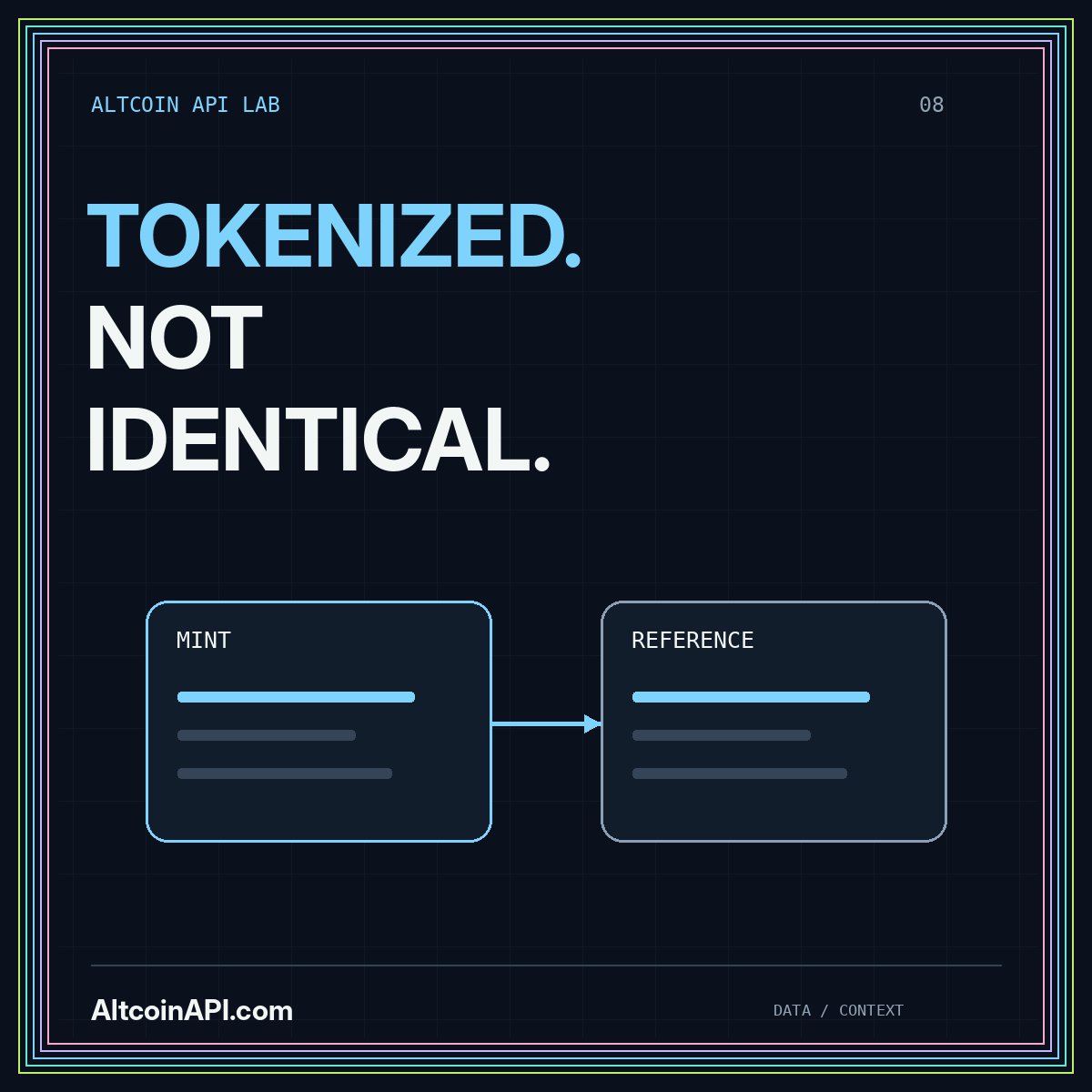
Give the Solana token and referenced Ethereum asset separate identifiers. Connect them through a relationship object recording the asserted mechanism, evidence, review state, and dates. Multiple Solana representations of one reference asset should remain distinct records with their own observations. Their shared reference does not erase differences between the representations.
Make relationships directional. A Solana record can reference an Ethereum contract without turning that contract into the same asset or implying a reverse redemption process. Store what the evidence says about issuance, conversion, or redemption rather than guessing direction from a common symbol or a similar product name.
A compact interface can show a product family or related-assets section. Keep this navigational grouping separate from economic equivalence. Grouping helps readers explore; equivalence is a substantive claim requiring a definition and support. An explicit graph provides useful navigation without forcing every member into one combined balance or price history.
Document conversion claims without adopting them
When a source describes a ratio, record the claimed conversion, units, source date, and conditions. Label it according to the actual review performed. Do not infer a permanent relationship from a name, logo, or a single comparison of market observations. Retain uncertainty where supporting terms are incomplete or unavailable.
A process may depend on an issuer, intermediary, or technical mechanism. Record those references only when supported by evidence. Leave missing fields missing instead of inventing counterparties because the schema designer expected one common architecture. The data model must accommodate incomplete knowledge without forcing a plausible but unsupported explanation.
Record revisions as dated events. A mapping may be withdrawn or a statement superseded. Preserve the earlier relationship and identify its replacement rather than rewriting the history of the underlying Solana mint. A researcher can then see which arrangement was asserted at the time of an observation.
Keep supplies and market observations distinct
Treat Solana mint supply and the reported supply of a referenced Ethereum token as separate quantities. Define a research purpose before aggregating them. Preserve original units and relationship assumptions so the calculation can be reviewed, rather than implicitly combining quantities merely because the display groups the assets together.
Keep market observations separate for each represented instrument. A reference-asset price should not automatically become the representation's price. Missing representation-specific data should stay missing unless an agreed derived-price method explicitly allows substitution and labels the output as calculated. Record that policy alongside every such derived value.
For comparisons, align quotation units and observation times. A difference based on mismatched units or stale inputs can look meaningful when it only reflects data handling. Preserve original inputs and age thresholds. Withhold comparisons when the declared conditions are not satisfied instead of silently smoothing away the mismatch.
Preserve a missing comparison
Imagine an illustrative sample where an Ethereum observation is recent but the Solana representation has no eligible market record for the interval. The relationship page can still show both identities and evidence. Its comparison field should say unavailable under the selected method rather than display a reference price as though it were a direct observation.
Track operational states without broad assurances
Keep observed technical state separate from statements about a representation mechanism. Do not combine them into one safe or backed badge. A parser reading configuration and a reviewer checking a document perform different tasks. Their results need distinct scope, evidence, and dates so one does not inherit the other's meaning.
When a process is described as paused or unavailable, preserve source and effective time. Do not generalize a source-specific report to every holder or route without evidence. Operational descriptions often need narrower language than a headline can comfortably accommodate, but preserving that precision is part of the data product's value.
Define how unknown states affect calculations. The application might continue displaying a token's identifier and recorded amount while withholding a relationship-based valuation. Useful observations can remain visible without implying every surrounding claim is established. The RWA evidence model uses the same separation for offchain reference relationships.
Design history around changing relationships
A time series needs asset observations and the relationship version applicable to the requested view. A point-in-time export may use only mapping information available at the original decision time. A corrected retrospective export can use later review while explicitly identifying itself as revised. Agree the intended view before interpreting historical results.
Do not splice two mint histories into one continuous series simply because a product describes a reissuance. Preserve old and new identities and record any supported migration relationship. A researcher can then choose how to aggregate them instead of inheriting an undocumented continuity assumption buried in the provider's data.
Include mapping version in each export manifest. This makes different related-asset groupings explainable across exports covering identical dates. The cause may be new evidence or revised classification rather than changed raw activity. A transparent archive separates these causes and identifies which interpretation was used for each result.
Test ambiguity before expanding coverage
Start with one clearly identified Solana token, one supported representation relationship, and one unresolved candidate. Include similar symbols, an outdated statement, and missing representation-specific market data. These cases test whether the schema communicates boundaries rather than expanding an incomplete claim into a confident description.
Ask a developer to build a display without inventing fields. Can it show relationships without merging identities? Can it explain why a reference price was not used? Can it preserve a historical mapping after a revision? These questions reveal more than a demonstration of a large, undifferentiated token list.
Specify evidence and market coverage commercially as well as technically. Broad Solana coverage does not define reviewed mappings, historical relationship versions, source-document access, or permission to redistribute summaries. Put these questions beside the requested fields in the brief so they can be evaluated as part of one clearly bounded project.
Make relationships portable between systems
Export relationships as records with stable identifiers rather than embedding them only in display prose. Include the source and destination asset keys, type of relationship, evidence references, and validity or review dates. A receiving application should be able to reconstruct the graph without extracting meaning from a paragraph written for a public page.
Keep application-specific group names optional. A portfolio screen, an editorial directory, and a research table may group the same records differently. Each can use the relationship evidence while maintaining its own presentation rules. This avoids tying underlying data identity to one interface's convenient but potentially temporary navigation structure.
Conclusion: a relationship is not an identity
Preserve each Solana mint as a distinct record and attach supported relationships to reference assets. Separate quantities, prices, operational statements, and historical mappings. Continue with the Ethereum altcoin guide and metadata provenance article to build a feed that stays understandable when asset relationships become complicated.